
Up to 30% less urea
Replace 1 kg of conventional urea with ~0.7–0.8 kg of UREGOLD without compromising yield.
UREGOLD PNP coated urea encapsulates high-purity urea inside a Potassium Nitrophenolate (PNP) shell. The result: nitrogen released across 150–200 days, sharply reduced leaching and volatilization, and a measurable yield uplift across paddy, wheat, maize, sugarcane and horticulture.
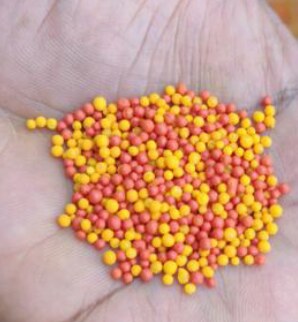
Replace 1 kg of conventional urea with ~0.7–0.8 kg of UREGOLD without compromising yield.
Sustained release matches crop demand from germination through grain fill — fewer losses, more uptake.
One application supports the full crop cycle, replacing multiple top-dressings.
Released PNP and potassium drive germination, root growth, chlorophyll synthesis and tillering.
Higher uptake efficiency lowers the true cost of nitrogen actually used by the crop.
Cuts NH₃ volatilization, N₂O emissions and nitrate leaching into groundwater.
Independent bio-efficacy field trials with TNAU and partners across paddy and maize.
A four-stage controlled-release mechanism that delivers nutrition exactly when plants need it.
Read moreThe 2-PNP, 4-PNP and 5-PNP active ingredients behind UREGOLD's coating.
Read moreHow PNP, polymer and sulfur coated ureas compare for modern, cost-conscious agriculture.
Read moreTrial design, observations and yield results from paddy and maize bio-efficacy studies.
Read moreThe yield, cost and environmental case for switching to PNP coated urea.
Read morePNP coated urea plus 2-PNP, 4-PNP and 5-PNP active ingredients in metric-ton volumes.
Read moreCommon questions from agronomists, distributors and growers evaluating PNP coated urea.
A practical introduction to PNP coated urea — what the coating does, why it improves nitrogen efficiency, and how it differs from conventional urea and neem-coated urea.
What Potassium Nitrophenolates actually are, how 2-PNP, 4-PNP and 5-PNP differ, and why this trio is the active backbone of modern bio-stimulant fertilizers.
Not all coated urea is the same. A side-by-side look at sulfur, neem, polymer and PNP coated urea — and where each one wins.